
Mineral processing plants move enormous volumes of ore, concentrate, tailings, and additives every hour. The material is abrasive, often hot, frequently dusty, and sometimes explosive — and the plant cannot stop. Behind every reliable mineral processing line is a bulk-material handling system engineered for exactly these conditions. This article explains how Tianyi Machinery designs and manufactures complete bulk-handling systems for mineral processing plants, and why our technical depth and production scale matter to plant builders and operators.
In this article
1. What a mineral processing plant demands from material handling 2. Tianyi's technical capability 3. Equipment lineup for a mineral processing plant 4. Production capacity that delivers complete systems 5. A representative system configuration 6. Why plant builders choose Tianyi1. What a Mineral Processing Plant Demands From Material Handling
Ore handling is unforgiving. Compared with general bulk goods, mineral processing duty has four defining challenges that decide whether a system runs for years or fails within months:
- Abrasion: Crushed rock, ore, and clinker wear through belts, liners, chains, and buckets. Equipment must use hardfaced surfaces and replaceable wear parts.
- High temperature: Sinter, clinker, and hot return material can exceed several hundred °C, ruling out standard seals and elastomers.
- Dust & environmental compliance: Every transfer, screen, and crusher discharges dust that must be captured to meet emission limits.
- Potential explosibility: Coal, sulfide ores, and fine concentrates create combustible-dust atmospheres that require explosion-proof actuators and isolated compartments.
The process chain typically runs: ROM receiving → primary crushing → conveying → screening/classification → intermediate storage (bins, surge hoppers) → secondary crushing / mill feed → vertical elevation → dust collection at every transfer. Single off-the-shelf machines rarely survive this chain. Success comes from an integrated design where each stage is selected for its specific duty — which is exactly the discipline Tianyi brings.
2. Tianyi's Technical Capability
Our advantage in mineral processing projects is not a single machine; it is the depth of engineering behind the whole system:
- 18+ years dedicated to bulk material handling, with 100+ national patents (including 13 invention patents) and 7 software copyrights.
- Standards-grade design: We have led or participated in drafting 3 national standards and 5 industry standards — our designs follow recognized benchmarks, not guesswork.
- Full in-house engineering: Process flow design, equipment selection, structural and drive calculation, and control-system integration are handled by one team, so interfaces never fall through the cracks.
- Custom engineering for difficult duty: Abrasive and high-temperature materials, sealed dust-tight conveying, and explosion-proof configurations (explosion-proof actuators, isolated compartments) for combustible-dust zones.
- Certified quality: ISO 9001 management system; recognized as a National High-tech Enterprise, National "Little Giant" Enterprise, Hubei Green Factory, and Hubei Province Manufacturing Champion.
- One supplier, every stage: From a single crusher to a complete conveying system, one responsible source covers the plant's entire material flow.

3. Equipment Lineup for a Mineral Processing Plant
Tianyi's product range maps directly onto every stage of an ore processing flowsheet. Use the table below as a first-pass scope:
| Process stage | Tianyi equipment | Key benefit |
|---|---|---|
| Receiving & crushing | Jaw / hammer / roll crushers; heavy apron feeder | Size reduction and controlled feed of ROM ore |
| Feeding | Vibrating, rotary & screw feeders | Uniform, metered feed; prevents bridging |
| Conveying | Belt (long-distance, up to 2,000 t/h), chain (abrasive / high-temp), screw (sealed, dusty), apron (heavy, hot) | Matched to material and duty |
| Vertical lift | Bucket elevators (TH / TD series) | Reliable elevation of ore and concentrate |
| Classification | Vibrating & rotary screens | Accurate sizing before next stage |
| Dust control | PPCS bag dust collectors | Compliant capture at every transfer point |
| Flow control | Plug-in, flap, slide gate & diverter valves | Routing, isolation, and batching |
4. Production Capacity That Delivers Complete Systems
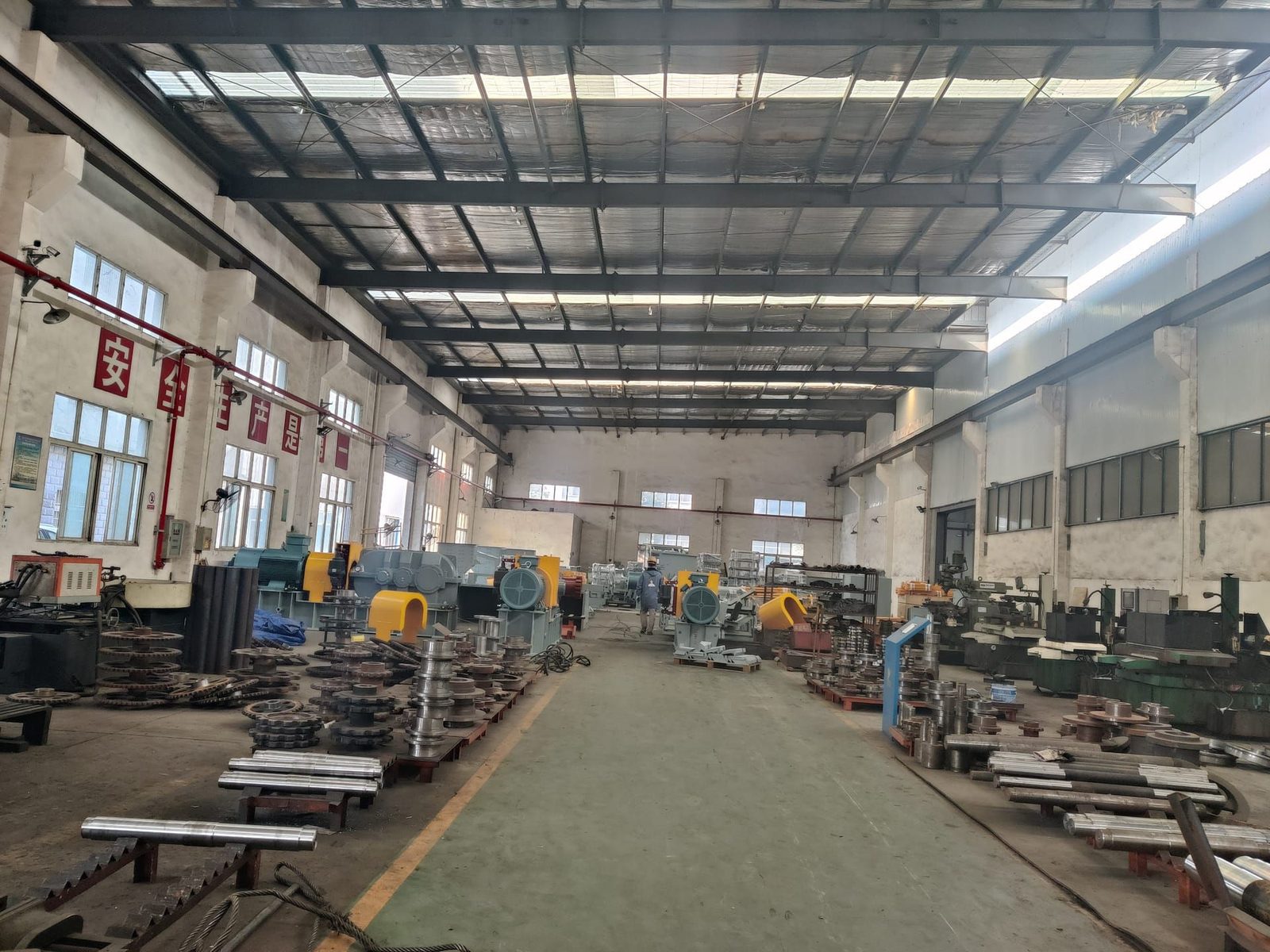
A design is only as good as the factory that builds it. Tianyi operates a 70,000 m² manufacturing base with 200+ engineers, technicians, and production staff. Our integrated production covers heavy machining, welding and fabrication, assembly, and in-house performance testing — so a complete system is built and verified under one roof.
- We don't just ship parts; we deliver mechanical, structural, drive, and control packages that arrive ready to integrate.
- Every unit passes quality control before shipment, and our OEM-quality spare-parts program (idlers, rollers, sprockets, chains, buckets, bearings) keeps your line running.
- Equipment from Tianyi is already operating in 50+ countries across mining, power, cement, and metallurgy — a track record that de-risks your project.
5. A Representative System Configuration
A typical configuration for an ore processing line looks like this:
- ROM ore is drawn from the stockpile by a heavy apron feeder and fed to a jaw crusher.
- Crushed ore is conveyed by a long-distance belt conveyor to a vibrating screen.
- Oversize returns to a secondary crusher in closed circuit; undersize drops to a surge bin.
- A chain conveyor moves material to a bucket elevator, which lifts it to the mill-feed bin.
- PPCS bag dust collectors are positioned at the crusher, screen, transfer points, and elevator discharge.
6. Why Plant Builders Choose Tianyi
- One-stop responsibility: Design, manufacture, commissioning, and after-sales from a single source.
- Standards-grade engineering that reduces project risk and shortens integration time.
- Scalable capacity — from a single conveyor line to a complete plant handling system.
- Global service: Technical consultation, installation supervision, and commissioning support wherever your project is located.
Frequently Asked Questions
What conveying equipment does a mineral processing plant need?
Crushing and feeding at receive, belt and en-masse conveyors for transport, bucket elevators for lift, screening, dust collection, and valves for routing.
Can Tianyi deliver a complete mineral-processing handling system?
Yes. We engineer the full material-handling scope from run-of-mine receiving to product screening and load-out as an integrated, commissioned system.
How does Tianyi handle abrasive ore and slurry?
We use wear-resistant liners, hardened chain and flights, and sealed casings, with material selection matched to the ore's abrasiveness and moisture.
Which industries does Tianyi serve beyond mining?
Cement, chemical, power, metallurgy, and new-energy, in addition to mineral processing and metal smelting.
What capacity can Tianyi systems handle?
System scale is engineered per project; typical lines handle hundreds to thousands of tons per hour across crushing, conveying, and screening.
Need a Bulk-Handling System for Your Mineral Processing Plant?
Send us your material, required capacity, and plant layout. We return a tailored system design and quotation — including crushers, conveyors, screens, elevators, dust collectors, and valves.
Request a Quote